



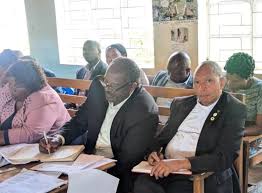
![Members of the Bwatwa community take part in the trainingat Mubano Hotel in Kisoro Municipality on 29/09/2025 [PHOTO: Dickens Twinomujuni]](https://vomuhabura.com/wp-content/uploads/2025/09/Members-of-the-Bwatwa-community-take-part-in-the-trainingat-Mubano-Hotel-in-Kisoro-Municipality-on-29-09-2025-PHOTO-Dickens-Twinomujuni.jpg)
The Batwa community in Kisoro, together with local leaders and stakeholders, are undergoing training aimed at safeguarding indigenous knowledge on traditional medicinal plants.
The two-day training, taking place at Mubano Hotel in Kisoro Municipality, is organized under the Institutional Capacity Strengthening for Implementation of the Nagoya Protocol, through the ABS project. The initiative targets indigenous peoples and local communities, with a special focus on the Batwa in southwestern Uganda, funded by the Global Environment Facility (GEF).
Speaking at the training, the Executive Director of United Organisation for Batwa Development Uganda (UOBDU), Penninah Zaninka, said the project seeks to conserve Uganda’s genetic resources and associated traditional knowledge, while ensuring equitable and sustainable benefit-sharing from their use.
“Our main goal is to conserve Uganda’s genetic resources and the traditional knowledge linked to them. We also want to ensure that the benefits from their use are accessed and shared equitably and sustainably,” said Peninah Zaninka, Executive Director of UOBDU.
Kisoro District LCV Chairperson, Abel Bizimana, commended participants for their commitment, adding that Kisoro stands ready to benefit from the project.
“I want to commend all the participants for their commitment. As Kisoro District, we must be ready to benefit from this project fully,” said Abel Bizimana, Kisoro District LCV Chairperson.
Meanwhile, members of the Batwa community welcomed the training, expressing their joy and commitment to supporting the preservation and use of herbal medicine.
“We are happy to take part in this training. As the Batwa community, we are committed to supporting and promoting the use of herbal medicine,” said members of the Batwa community who attended the training.
Herbal medicine is widely used in Uganda by over 60% of the population, especially in rural areas, due to accessibility, affordability, and cultural familiarity. It serves as a primary source of healthcare for common ailments like malaria, respiratory problems, cough, skin diseases and digestive issues.
However, the unregulated trade of herbal products, the lack of scientific testing for safety and efficacy, and unsustainable harvesting practices pose risks and threaten the conservation of medicinal plant diversity.
Established in 2000, UOBDU brings together the Batwa communities to address their land problems and help them develop sustainable alternative livelihoods.
There are approximately 6,700 Batwa in southwestern Uganda, though exact numbers are debated due to varying estimates and sources. The majority of the country’s estimated total Batwa population, which is approximately 6,700, resides in the southwest, with populations concentrated in districts such as Kisoro, Kabale, and Kanungu, where they were displaced from their ancestral forest homes.




Discussion about this post